



.svg.png)

In today's rapidly evolving digital era, businesses face unprecedented pressure to modernize their operations, enhance customer experiences, and stay competitive. Digital transformations have become essential for survival, yet the complexity of a digital transformation can overwhelm even the most forward-thinking organizations. This comprehensive guide explores how digital transformation consulting services can help your company navigate these challenges, implement effective transformation strategies, and achieve sustainable growth. Whether you're considering hiring consulting firms or developing your in-house capabilities, understanding the role of digital transformation consulting services is crucial for success in the modern digital landscape.
What Is Digital Transformation Consulting and Why Does Your Business Need It?
Digital transformation consulting is a specialized service that helps organizations reimagine their business models, operations, and customer experiences through strategic implementation of digital technologies. Unlike traditional IT consulting, consulting in digital transformation takes a holistic approach, addressing people, processes, and technology simultaneously to drive meaningful change.
The complexity of a digital transformation stems from its comprehensive nature. It's not simply about adopting new software or migrating to the cloud — it requires fundamental shifts in organizational culture, operational workflows, and strategic thinking. A digital transformation consulting firm brings expertise across multiple domains, including strategy development, change management, technology architecture, and implementation planning. VisioneerIT's AI Adoption and Strategic Planning services are built precisely around this multi-domain approach, ensuring that technology investments are tightly aligned to business objectives from day one.
Business leaders increasingly recognize that digital transformation is essential for maintaining competitive advantage. According to research from McKinsey & Company, companies that successfully execute digital transformation initiatives achieve 20–30% improvements in customer satisfaction and operational efficiency. However, the same research indicates that 70% of digital transformation projects fail to meet their objectives — highlighting the critical need for experienced consulting partner support.

How Do Digital Transformation Strategies Drive Business Growth?
Effective digital transformation strategies serve as the foundation for sustainable growth and competitive differentiation. These strategies align digital initiatives with core business objectives, ensuring that technology investments deliver measurable value rather than becoming expensive distractions.
Strategy consulting firms specializing in digital transformation help organizations develop clear roadmaps that prioritize initiatives based on impact and feasibility. This structured approach to digital innovation prevents the common pitfall of pursuing trendy technologies without understanding their business applications. According to Forrester Research, organizations that tie their digital transformation strategies directly to measurable business outcomes are 1.8x more likely to sustain transformation momentum past the initial implementation phase. The National Institute of Standards and Technology also emphasizes that successful digital transformation requires alignment between technology capabilities and organizational readiness.
Transformation strategies typically encompass several key components: digital strategy development for customer engagement, operational optimization through automation and analytics, workforce upskilling to build digital capabilities, and infrastructure modernization including cloud migration. When properly executed, these strategies create synergies that amplify results. For example, customer experience transformation initiatives become more powerful when supported by robust data analytics and workflow process automation. For a deeper look at how technology and business strategy connect to drive long-term growth, explore our post on winning technology strategies for business growth.
What Services Do Digital Transformation Consulting Firms Provide?
Consulting firms specializing in digital transformation offer comprehensive service portfolios designed to address every phase of the digital transformation journey. Understanding these services provided by digital transformation consultancies helps organizations select the right consulting partner for their specific needs.
Digital transformation consulting services typically begin with assessment and strategy development. Consultants evaluate current digital maturity, identify gaps and opportunities, and develop prioritized roadmaps. This diagnostic phase is crucial — the Harvard Business Review notes that organizations that invest adequate time in assessment and planning are three times more likely to achieve their transformation goals.
Implementation services represent the core of what consulting firms provide. These include solution design and architecture, software selection and integration, cloud migration and infrastructure modernization, and change management support. Many firms also offer artificial intelligence adoption services, helping organizations leverage AI to automate processes, enhance decision-making, and create innovative customer experiences. VisioneerIT's Software Engineering and Workflow & Process Automation services deliver exactly this kind of hands-on implementation capability — purpose-built for organizations that need to modernize fast without disrupting ongoing operations.
Beyond implementation, transformation services often include ongoing optimization, training, and support. The best digital transformation partnerships evolve from project-based engagements into long-term relationships where consultants serve as trusted advisors, helping organizations adapt to emerging technologies and market shifts.
The ROI of Digital Transformation Consulting: What the Data Actually Shows
One of the most common questions leaders ask before engaging digital transformation consulting services is straightforward: what is the actual return on investment? The data is compelling — when digital transformations are executed with structured consulting support, the financial and operational returns consistently outpace those of unguided initiatives.
According to IDC research, organizations that invest in comprehensive digital transformation consulting services report an average of 20–30% improvement in operational efficiency within the first two years. MIT Sloan Management Review data shows that companies successfully executing digital transformations generate 26% higher profitability than industry peers who do not. At the enterprise level, every dollar invested in digital transformation consulting generates an average of $2.40–$3.20 in measurable business value — when digital initiatives are properly aligned to revenue, efficiency, or customer experience objectives.
The cost of not investing in structured consulting is equally significant. McKinsey estimates that failed digital transformation projects — those that stall or miss their objectives — waste an average of $1.2 trillion in global investment annually. The primary drivers of failure are inadequate strategy, poor change management, and misaligned technology selection. These are precisely the risks that experienced digital transformation consulting firms are equipped to mitigate from the outset. For leaders seeking to understand how data-driven analysis can sharpen transformation ROI projections, our blog post on AI in Business Intelligence provides essential context on how modern analytics tools are reshaping strategic decision-making.
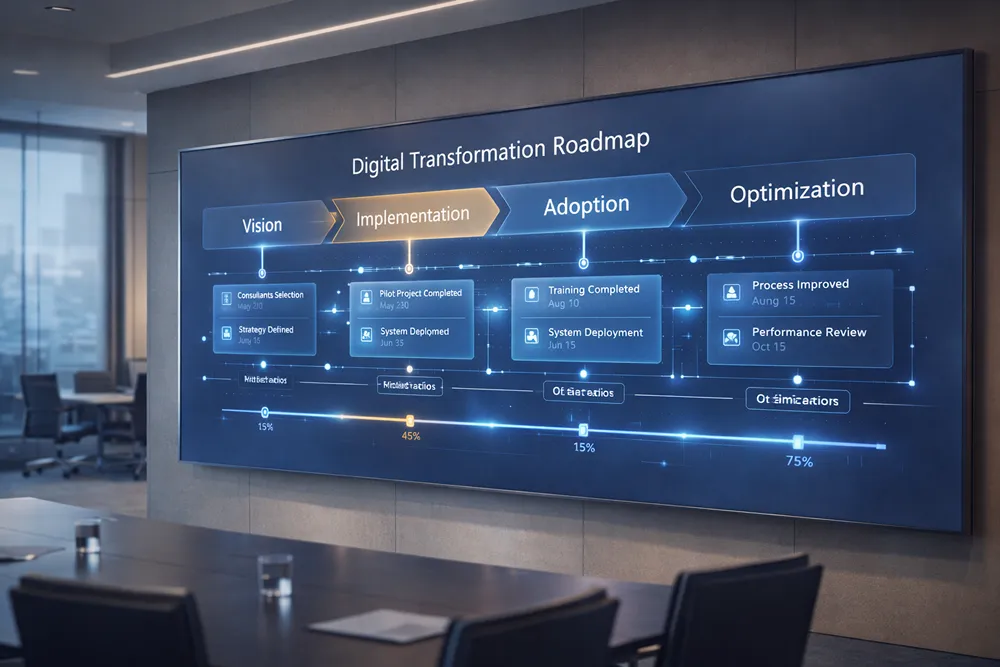
The Digital Transformation Consulting Framework: A Proven 4-Layer Model
Successful digital transformation requires more than a list of technology projects — it demands a structured framework that connects every workstream to measurable business outcomes. The most effective digital transformation consulting engagements organize work across four interconnected layers:
Layer 1 — Strategy: Define the business case, set transformation goals, prioritize digital initiatives, and establish the roadmap that guides every downstream decision. This layer ensures every investment is tied to a specific business objective with a measurable KPI.
Layer 2 — Technology: Assess, select, and integrate the right digital technologies — cloud platforms, automation software, data infrastructure, AI tools, and security architecture. Technology decisions must flow from strategy, not precede it.
Layer 3 — People: Address change management, workforce upskilling, and leadership alignment. Successful digital transformation requires human adoption, not just technical deployment. According to Gartner, people and culture issues are the single most cited barrier to digital transformation success — identified by 46% of executives surveyed.
Layer 4 — Operations: Govern execution through phased rollout plans, governance structures, KPI frameworks, and continuous improvement cycles. This layer sustains transformation momentum past the initial go-live and ensures the organization continues to evolve.
All four layers must be addressed simultaneously and iteratively throughout the engagement. Digital transformation consulting services that focus exclusively on technology while neglecting the People and Operations layers are among the most common patterns in failed transformations. VisioneerIT's Training & Development and Workforce Development services directly support Layer 3 — ensuring your teams are prepared, confident, and capable of owning the transformation outcomes long after consulting engagement closes.
Illustrative Example: How a Federal Agency Could Cut Operational Costs by 35%
To illustrate what comprehensive digital transformation consulting can deliver in practice, consider this scenario from the government and defense sector, VisioneerIT's primary area of domain expertise. It is an illustrative composite based on common patterns in federal programs, not a specific client engagement, and the figures are indicative targets rather than reported results.
Picture a federal agency running on aging legacy systems, fragmented data workflows, and manual reporting processes. It faces compounding compliance pressure, an imminent contract renewal cycle, and a workforce not yet equipped for the digital operating model required by new federal mandates. It brings in a partner to redesign its operational technology infrastructure and data intelligence capabilities.
The engagement starts with a full digital readiness assessment: mapping legacy workflows against modern digital capabilities, identifying compliance gaps, and quantifying the cost of inaction. From there, a phased transformation roadmap runs across three program workstreams. Phase one migrates core operational systems to the cloud, eliminating on-premise infrastructure costs and enabling real-time data access across agency divisions. Phase two deploys automated reporting dashboards connected to live operational data, replacing a manual process that consumes significant analyst hours every week. Phase three integrates AI-assisted decision support tools to reduce manual review cycles for high-volume regulatory workflows.
A program like this can realistically target around a 35% reduction in operational costs over 16 months, a 42% improvement in reporting accuracy, and full ROI within about 13 months. This type of structured, phased approach, anchored in the 4-Layer Framework above, is what separates transformations that deliver from those that stall. For VisioneerIT's actual track record with federal clients, see our Federal Experience case study.
Why Should You Hire a Digital Transformation Consulting Firm?
The decision to hire a digital transformation consulting partner represents a strategic investment that can dramatically accelerate your company's modernization efforts while reducing risk. Several compelling factors drive this decision.
First, specialized expertise addresses knowledge gaps that exist in most organizations. Digital transformation consultants bring cross-industry experience, having implemented solutions across diverse sectors and use cases. This breadth of experience helps companies avoid common pitfalls and adopt best practices proven in real-world scenarios. Gartner research indicates that organizations working with experienced consulting firms complete digital transformation initiatives 40% faster than those relying solely on internal resources.
Second, objective perspective proves invaluable when navigating digital transformation. Internal teams often carry biases based on existing systems and processes, making it difficult to envision radical change. A consulting firm for digital transformation provides fresh eyes, challenging assumptions and identifying opportunities that might otherwise remain hidden.
Third, resource flexibility allows organizations to scale expertise up or down as project needs evolve. Rather than hiring permanent staff with specialized skills needed only temporarily, companies can engage consultant teams for specific project phases. This scaling approach optimizes costs while ensuring access to top talent precisely when needed. Our blog post on the essential role of an IT consultant explores in greater depth how the right consulting relationship accelerates capability building across the organization.

What Makes a Successful Digital Transformation Engagement?
The success of digital transformation efforts depends on multiple interconnected factors that extend beyond technology selection and implementation. Understanding these success criteria helps organizations structure effective digital transformation engagement models with their chosen consulting partner.
Clear strategy and executive sponsorship form the foundation. Successful digital transformation always begins with leadership commitment and a well-articulated vision. When executives actively champion digital transformation efforts, they signal to the entire organization that change is both necessary and supported. The digital transformation strategy consulting process should produce tangible deliverables — specific goals, timelines, resource allocations, and success metrics that guide implementation.
Cultural readiness and change management represent another critical dimension. Digital transformation involves fundamental shifts in how people work, requiring companies to address resistance, provide training, and celebrate early wins. According to research from the MIT Sloan Management Review, organizational culture issues cause more digital transformation projects to fail than technology problems. An effective consulting partner helps organizations develop comprehensive change management programs that build momentum and sustain engagement throughout the journey.
Agile implementation methodology accelerates value delivery while managing risk. Rather than pursuing massive multi-year initiatives, successful digital transformation consulting engagements break projects into manageable phases with clear milestones. This approach to digital transformation allows organizations to demonstrate quick wins, adjust course based on learnings, and maintain stakeholder support throughout the journey. For organizations looking to build the project governance infrastructure that enables this kind of disciplined execution, VisioneerIT's Project Management services provide the operational backbone that keeps complex transformation programs on track and on budget.
How Do You Choose the Right Digital Transformation Consultancy?
Selecting a consulting partner requires careful evaluation across multiple dimensions to ensure alignment with your organization's needs, culture, and objectives. The wrong choice can waste resources and set back your digital agenda by years, while the right consulting firm accelerates progress and builds internal capabilities.
Industry expertise and relevant experience should top your evaluation criteria. Ask potential consulting firms about their work in your sector, requesting case studies and client references. Firms specializing in digital transformation for government contractors, for example, understand compliance requirements, procurement processes, and security standards that general consultants might overlook. The ability to navigate the complexities of digital transformation in your specific context dramatically improves outcomes.
Service breadth and solution ecosystem matter significantly. Comprehensive digital transformation requires expertise spanning strategy, technology, data, customer experience, and organizational change. Evaluate whether consulting firms offer end-to-end capabilities or require multiple partners to deliver complete solutions. Additionally, assess their technology partnerships — do they maintain vendor neutrality, or do they push specific software or cloud platforms?
Delivery methodology and cultural fit often determine success of digital transformation initiatives as much as technical expertise. During evaluating digital transformation consulting candidates, pay attention to their proposed engagement model. Will they work collaboratively with your team, building internal capabilities, or operate independently? The best partnerships transfer knowledge systematically, ensuring your organization can sustain digital transformation efforts after consultants depart. Consider firms that emphasize customer user experience and prioritize stakeholder engagement throughout the process.
What Role Does Cloud Technology Play in Digital Transformations?
Cloud computing serves as a fundamental enabler of modern digital transformations, providing the scalability, flexibility, and innovation platform that companies need to compete in the digital environment. Understanding cloud strategy represents a critical component of comprehensive digital transformation consulting.
Cloud migration delivers multiple strategic advantages beyond cost optimization. It enables rapid scaling of resources to meet demand fluctuations, eliminates capital expenditure for hardware infrastructure, and provides access to cutting-edge capabilities including artificial intelligence, machine learning, and advanced analytics. Organizations that prioritize cloud adoption in their digital transformation strategies position themselves to leverage digital technologies to drive innovation continuously. For a detailed breakdown of cloud migration strategy, risk management, and proven implementation approaches, our comprehensive blog post on cloud migration benefits, risks, and proven strategies is essential reading before embarking on any cloud workstream.
However, effective cloud strategy requires more than simply moving applications from on-premises servers to hosted infrastructure. A holistic digital transformation approach considers which workloads belong in public cloud, private cloud, or hybrid configurations. It addresses data governance, security, compliance, and integration with existing systems. The Cloud Security Alliance provides widely adopted frameworks for managing risks associated with digital transformation involving cloud technologies.
Digital transformation consultants help organizations develop cloud roadmaps aligned with business priorities. They assess application portfolios, prioritize migration candidates, select appropriate cloud platforms, and manage the technical and organizational aspects of migration. This expertise proves particularly valuable when organizations pursue multi-cloud strategies, requiring integration across AWS, Azure, Google Cloud, or other providers.
How Do Digital Transformation Initiatives Impact Customer Experience?
Customer experience transformation represents one of the most visible and impactful applications of digital transformations. Organizations increasingly recognize that digital capabilities directly influence customer satisfaction, loyalty, and lifetime value — making customer-centric digital initiatives a top priority.
Digital technologies enable personalization at scale, allowing companies to tailor interactions based on individual preferences, behaviors, and contexts. Modern customers expect seamless experiences across channels — web development engineering, mobile apps, social media, and physical locations should provide consistent, integrated experiences. Organizations that implement digital solutions for omnichannel engagement report significant improvements in customer retention and acquisition efficiency.
Data and analytics capabilities transform how organizations understand and serve customers. By capturing and analyzing customer interactions across touchpoints, companies generate insights that drive product development, marketing optimization, and service improvements. These digital solutions move organizations from reactive customer service to proactive engagement that anticipates needs and prevents problems.
The impact of digital technologies on customer experience extends to back-office operations as well. When organizations invest in workflow process automation and integration of digital technologies across their operations, they reduce response times, improve accuracy, and free employees to focus on high-value customer interactions. This end-to-end approach to digital ensures that customer-facing improvements rest on solid operational foundations.
What Are Common Obstacles in Digital Transformation and How Do You Overcome Them?
Overcoming obstacles in digital transformation requires understanding the multifaceted challenges organizations face and developing proactive strategies to address them. Digital transformation consulting is crucial precisely because these challenges often prove difficult for internal teams to recognize and resolve.
Legacy technology represents a primary barrier for many organizations. Outdated systems create technical debt that limits agility and increases maintenance costs. However, wholesale replacement proves prohibitively expensive and risky for most companies. Effective consulting for digital transformation develops migration strategies that modernize infrastructure incrementally — wrapping legacy systems with APIs, implementing middleware for integration, or gradually replacing components based on business priority. Our AI Governance & Compliance service also plays an important supporting role here, ensuring that modernization efforts remain compliant and auditable throughout the transition.
Organizational resistance and change fatigue slow digital transformation efforts significantly. People naturally resist changes that disrupt familiar routines, especially when previous change initiatives failed to deliver promised benefits. Strategy and change management expertise helps organizations build change readiness through transparent communication, stakeholder involvement, training programs, and recognition systems that reward adoption.
Skills gaps prevent many organizations from fully achieving their digital potential. The rapid pace of technological change means that digital skills become outdated quickly, requiring continuous learning. Digital transformation consulting services help by providing training, building centers of excellence, and establishing knowledge transfer processes that build sustainable internal capabilities. They also help organizations make strategic decisions about which capabilities to develop internally versus sourcing externally.
Budget constraints and ROI uncertainty create another common obstacle. Leadership teams struggle to justify significant investments when outcomes remain uncertain. The best digital transformation approaches address this by structuring initiatives in phases with clear value milestones. Early successes build confidence and fund subsequent phases. Transformation consulting is a service that should demonstrate measurable value quickly while working toward longer-term strategic objectives. For a practical framework on quantifying transformation value at each phase gate, explore our blog post on complete guide to AI implementation — which covers ROI measurement models applicable across broader digital transformation programs as well.
How Do You Measure the Success of Digital Transformation Projects?
Measuring the success of digital transformation requires balanced scorecards that track financial, operational, customer, and organizational metrics. Unlike traditional IT projects focused on delivery timelines and budgets, digital transformation initiatives demand broader evaluation frameworks.
Financial metrics provide essential accountability. Organizations should track return on investment, cost savings from automation and efficiency improvements, revenue growth from digital channels, and working capital optimization. However, financial results often lag implementation by months or years, making them insufficient as sole performance indicators.
Operational metrics demonstrate process improvements and efficiency gains. These include cycle time reductions, error rate decreases, productivity improvements, and system uptime. For example, organizations implementing workflow process automation might measure the percentage of transactions completed without manual intervention, or average processing time for key workflows.
Customer metrics reveal whether digital transformation delivers on its promise of enhanced experiences. Net Promoter Score, customer satisfaction ratings, digital engagement rates, and channel preference shifts all indicate how customers respond to new digital capabilities. Organizations should establish baseline measurements before launching initiatives, then track changes over time.
Organizational health indicators assess whether digital transformation builds sustainable capabilities. These include employee digital skill levels, adoption rates for new tools and processes, innovation pipeline metrics, and cultural assessment scores. The digital transformation consultancy should help establish realistic targets and implement measurement systems that provide actionable insights throughout the journey.
Key Takeaways for Your Digital Transformation Journey
- Digital transformation consulting provides specialized expertise that helps organizations navigate the complexities of digital change while avoiding common pitfalls that cause 70% of initiatives to fail
- Effective digital transformation strategies align technology investments with business objectives, creating clear roadmaps that prioritize initiatives based on impact and feasibility
- The 4-Layer Framework — Strategy, Technology, People, and Operations — is the structural foundation of every successful transformation engagement; neglecting any layer significantly increases failure risk
- ROI data is compelling: organizations with structured consulting support report 20–30% operational efficiency gains, 26% higher profitability, and $2.40–$3.20 return per dollar invested in transformation
- Comprehensive digital transformation consulting services span assessment and strategy development, solution implementation, change management, and ongoing optimization
- Selecting a consulting partner requires evaluating industry expertise, service breadth, delivery methodology, and cultural fit to ensure alignment with your organization's needs
- Cloud technology serves as a fundamental enabler, providing the scaling, flexibility, and innovation platform necessary for modern digital transformations
- Customer experience transformation is one of the most visible impacts of digital transformation — personalization, omnichannel engagement, and data-driven insights drive satisfaction and loyalty
- Common obstacles — legacy technology, organizational resistance, skills gaps, budget constraints — are all addressable through structured approaches and experienced guidance
- Measuring success of digital transformation initiatives requires balanced scorecards tracking financial, operational, customer, and organizational metrics
- The digital transformation journey should progress through manageable phases with clear milestones, allowing organizations to demonstrate quick wins while building toward long-term strategic objectives
- Achieving digital transformation success requires executive sponsorship, cultural readiness, agile methodology, and a consulting partner that transfers knowledge and builds sustainable internal capabilities
Ready to navigate your digital transformation with a proven consulting partner? Contact VisioneerIT to start the conversation.

%402x.svg)
%402x.svg)

